Sunday, September 6, 2015

Government considers extending maternity leave to boost child nutrition

NEW DELHI: The government is considering extending maternity leave to 24 weeks from 12 weeks, a government official said on Friday, adding that it would encourage more women to breastfeed and help reduce high rates of child malnutrition in the country.

"We feel the current three months is not enough time for women to adequately care for their newborns," said an official from the ministry of women and child development.

"The proposal, if approved, would give working women in all sectors -- public, private and even the informal sector such as domestic workers -- some kind of protection."

According to the ministry, an expectant mother needs one month of rest before birth, and seven months after, to adequately nurse her child, said the official, who declined to be named.

India has one of the highest child malnutrition rates in the world. Forty-six percent of children under five are underweight and 48 per cent are stunted, according to the latest government figures from 2005/6.

Child malnutrition is an underlying cause of death for 3 million children around the world every year 

nearly half of all child deaths - with most dying from preventable illnesses due to weak immune systems, says the United Nations Children's Fund.

Those who survive, grow up without enough energy, protein, vitamins and minerals, causing their brains and bodies to be stunted which means they cannot fulfill their physical, academic or economic potential.

The World Health Organization (WHO) - which recommends exclusive breastfeeding for babies up to six months old - says breastfeeding reduces child mortality and has proven health benefits that extend into adulthood.

Yet only 47 per cent of Indian mothers exclusively breastfeed for the first six months, compared with 70 percent in neighbouring Nepal and 76 per cent in Sri Lanka.

Gender experts say extending maternity leave will also encourage more women to return to work and close the gender gap in the labour market. Many women reluctantly drop out of work because they need more time for their newborns, they say.

At around 33 per cent, female participation in the workforce in India is well below the global average of 50 percent, a March report by the International Monetary Fund (IMF) said.

During to a visit to India in March, IMF Managing Director Christine Lagarde said the gender disparity in the labour sector was a "huge missed opportunity".
 
Source :http://economictimes.indiatimes.com/

S B Order No : 10 / 2015 - Implementation of Pradhan Mantri Jeevan Jyoti and Suraksha Bima Yojaja (PMJJBY & PMSBY) in CBS Post Offices


Saturday, September 5, 2015

Happy Teacher's Day


Good Teachers are gift of god,


Teachers are our living lord.
Lets celebrate teacher’s day,
Sarvpalli Radhakrishnan’s Birthday.

Discipline, Manners & like things,
we become queens and kings.
Good Teachers are gift of god,
Make our knowledge very broad.
They are very good preachers,
Make us a person with good features.
Sometime love us, sometimes beat.
Make our life very sweet.
Good Teachers are gift of god,
Use your pen like a sword.
Some give life, some give thumb,
They make us very handsome.
They are our good founder,
Make us all rounder.
Good Teachers are gift of god,
Be Honest and do not fraud.
Give all of them due respect,
It is Jasleen’s small request.
May all of them live very long,
Make the country very strong.

Focus of Pradhan Mantri Jan Dhan Yojana (PMJDY) moves from account opening to the provision of cash-out facilities (24 KB) PDF FileOpens in a new window(Dated 4th September, 2015)

Friday, September 4, 2015

HAPPI JANMASHTAMI 2015

https://encrypted-tbn0.gstatic.com/images?q=tbn:ANd9GcTUiQr4SDBiw7rd4-IBgBLu01gmekALW2QoMTkoKADZdqp4fpjK9w

unions eye Rs 15,000 per month minimum wage as national baseline Trade unions eye Rs 15,000 per month minimum wage as national baseline

By Subodh Varma, TNN
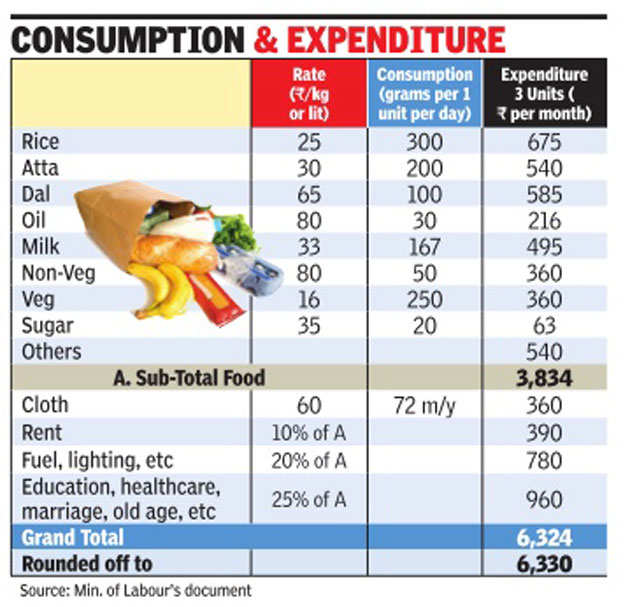
One of the key issues on which the negotiations between the government and the 10 central trade unions that had called for a general strike on Wednesday broke down was that of minimum wages. A labour ministry document circulated amongst the trade unions days before the strike, argued that by current norms, prices and calorific needs, Rs.6330 per month is the monthly wage adequate for an unskilled worker with a wife and two small children. 
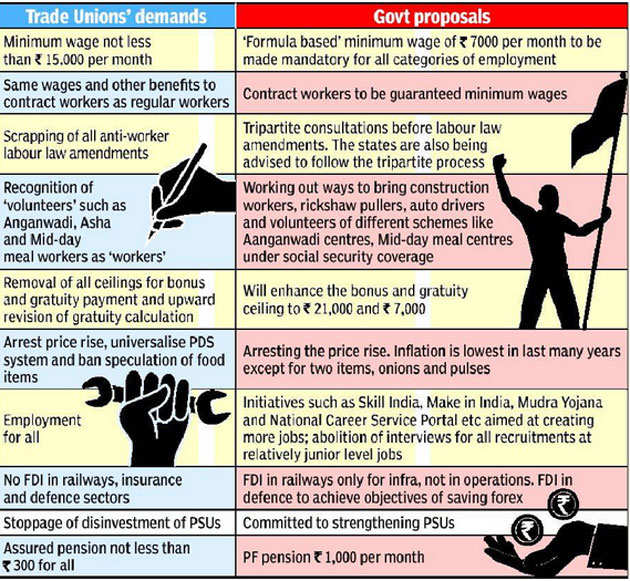
The trade unions and various other federations that represent 15 crore workers had demanded Rs.15,000 per month minimum wage as a national level floor wage. Striking a generous posture, the government modestly increased its proposal to Rs.7098 per month. 
What the government had proposed was less than half of what was demanded. This was one of the contributory factors to the breakdown of negotiations. Other demands of the workers included social security coverage, non-interference with existing labour laws, etc. 
How did the government calculate their proposal? A look at the fine print shows a slew of gross under-estimations and the use of an archaic formula first spelled out way back in 1957. Some of the food items' prices are far from reality. For instance dal is costed at Rs.65 but only one of the various dals in the market - chana or gram dal - comes in this range. Arhar (tur) is Rs.135 per kg, urad is Rs.117.5, masur is Rs.95. All these current retail prices are from the consumer affairs ministry's price monitoring data spanning 81 cities and towns. 
Mutton is priced at a bizarre Rs.80 per kg, although it doesn't really matter because only 50 g is allowed. This is convertible to 250 grams of vegetables which are priced at an imaginary Rs.16 per kg. In the real world mutton is selling at anywhere between Rs.300 to Rs.400 per kg. And rarely if any vegetable sells at Rs.16 per kg. 
But the real rub comes in the non-food items. Just Rs.390 is supposed to be spent on rent every month. And, fuel for cooking and utilities like electricity etc. are all supposed to be covered under a meagre Rs.780. 
All education, medical expenses, marriages, care of elderly, recreation etc. is lumped together and costed at 25 percent of the food expenditure. This practice started after the Supreme Court in a landmark judgement in 1991 directed as much saying that if such a minimum wage cannot be guaranteed then the managements have no right to run their business. But even this works out to a mere Rs.980 per month. 
Costs of education and healthcare have risen tremendously in the past several years and even one major episode of sickness in the family would be devastating. The government's wage calculation seems to be blissfully unaware of this. 
Recent government data shows that real wages, that is, after adjusting for inflation are dipping while the share of wages to profits is also dipping in the organized sector. In the unorganized sector which employs over 90 percent of India's workforce, wages are abysmally low and conditions of work onerous. Small wonder then that the trade unions were unwilling to accept the government's proposals.
Source : The Economic Times

Pradhan Mantri Jeevan Jyoti Bima Yojana (PMJJBY) and Pradhan Mantri Suraksha Bima Yojana (PMSBY) are going to be launched in all the CBS Post Offices w.e.f. 7th September, 2015